Paris-Aligned Scope 3 CO2e Emissions Data Protocol
Created a Scope 3 emissions data protocol that standardizes CO2e estimation and tracking, using an activity-based approach at portfolio level with minimal inputs - also suitable for SMEs using basic data like employee count and revenue - enabling transparent, comparable benchmarking.


Aim
By standardizing how Scope 3 CO2e is estimated, completed, and disclosed, the protocol provides investors, data providers, and companies with a reliable basis to manage climate-related risks and opportunities - supporting the reallocation of capital toward a sustainable economy.
Complexity of Handling Scope 3 Emissions
Unlike Scope 1 and 2, Scope 3 emissions sit across the value chain - indirect, outside a company's direct control, and highly complex, often seeming "unmeasurable" at first glance - yet they account for around 75-80% of total emissions and are therefore pivotal for the climate transition.(Club de Madrid, 2024) Today, Scope 3 data is typically incomplete, delayed, and inconsistent - and without standardization, comparability and benchmarking remain fragile - but it's essential for credible decarbonization strategies, Paris-aligned decisions, and benchmarking.
Switch the Perspective - Make Complexity Manageable
Making Scope 3 manageable starts with a change in perspective: instead of classifying companies under an average sector label, the protocol proposes treating companies as portfolios of real-world activities. That shift enables more precise attribution of emissions and - crucially - reduces double counting across value chains and portfolios.
A Stakeholder-Based Approach
Built through a participatory, cross-stakeholder process and stress-tested with investors, data providers, policymakers, corporates, and academics - via workshops and benchmark community sessions with partners including AP2, SEB, Bloomberg, Amundi, Imperial College London, GFANZ, and the European Commission’s JRC - designed to work in practice and strengthening acceptance and real-world usability.
Stakeholder convenings
Key Innovations of the Protocol
- 01
Activity-based approach (the paradigm shift)
The protocol treats companies not as monolithic entities, but as portfolios of economic activities. This enables more precise emissions attribution, reduces double counting along the value chain, and provides a robust basis for differentiated steering of climate impact.
Principle 7 Principle 8 Principle 9
- 02
Harmonized with financial reporting
Aligning Scope 3 data handling with financial reporting logic ensures consistency over time and improves comparability across companies and portfolios.
Principle 3 Principle 4 Principle 5
- 03
Materiality built in
The protocol distinguishes and prioritizes materially effective (and secondarily efficient) activities along the value chain to keep attention on the main emission sources, cut complexity, and curb greenwashing.
Principle 10
- 04
Precautionary Principle
Where Scope 3 data is uncertain or missing, emissions are estimated conservatively in favor of climate protection. This creates a strong incentive for companies to improve measurement and disclosure, while still enabling investors to achieve high coverage even with gaps.
Principle 1 Principle 6
Protocol estimation workflow applying the precautionary principle.Source: SDGLabs.ai - 05
Robust with limited data (proof of concept)
Robust Scope 3 CO2e estimates remain possible using only basic company inputs (e.g., revenue and headcount), validated in an SME proof-of-concept including firms with fewer than 20 employees.
EU Integration
The protocol is explicitly aligned with the EU sustainable finance and reporting framework - anchored in EU Paris-Aligned/Climate Transition Benchmarks and the CSRD — by providing a science-based method to estimate, complete and standardize Scope 3 where disclosures are missing or inconsistent.
Scope 3 inclusion is effectively mandatory for PAB methodologies under Commission Delegated Regulation (EU) 2020/1818 and has been phased in across all sectors since 23 December 2024.(European Commission, 2020)
Crucially, elements of the protocol have already been incorporated into EU guidance: Principle 3 (timely data processing) and Principle 10 (focus on main emission sources/materiality) were integrated into the Handbook of Climate Transition Benchmarks and Paris-Aligned Benchmarks (updated 21 March 2025), demonstrating direct EU-level uptake.(European Commission, 2025)
Key People



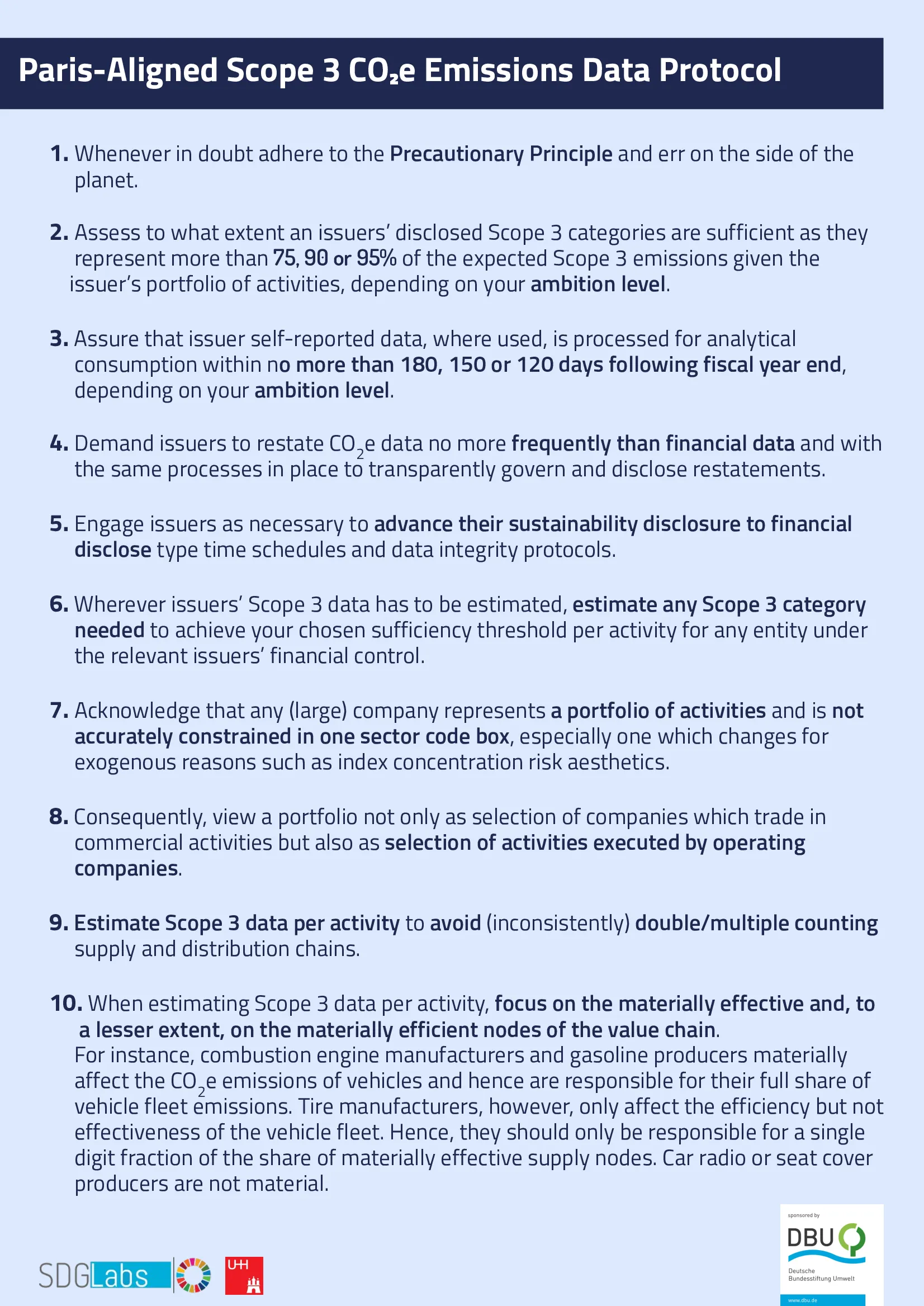
Paris-Aligned Scope 3 CO2e Emissions Data Protocol
- 01
Whenever in doubt adhere to the Precautionary Principle and err on the side of the planet.
- 02
Assess to what extent an issuers’ disclosed Scope 3 categories are sufficient as they represent more than 75, 90 or 95% of the expected Scope 3 emissions given the issuer’s portfolio of activities, depending on your ambition level.
- 03
Assure that issuer self-reported data, where used, is processed for analytical consumption within no more than 180, 150 or 120 days following fiscal year end, depending on your ambition level.
- 04
Demand issuers to restate CO₂e data no more frequently than financial data and with the same processes in place to transparently govern and disclose restatements.
- 05
Engage issuers as necessary to advance their sustainability disclosure to financial disclose type time schedules and data integrity protocols.
- 06
Wherever issuers’ Scope 3 data has to be estimated, estimate any Scope 3 category needed to achieve your chosen sufficiency threshold per activity for any entity under the relevant issuers’ financial control.
- 07
Acknowledge that any (large) company represents a portfolio of activities and is not accurately constrained in one sector code box, especially one which changes for exogenous reasons such as index concentration risk aesthetics.
- 08
Consequently, view a portfolio not only as selection of companies which trade in commercial activities but also as selection of activities executed by operating companies.
- 09
Estimate Scope 3 data per activity to avoid (inconsistently) double-/multiple counting supply and distribution chains.
- 10
When estimating Scope 3 data per activity, focus on the materially effective and, to a lesser extent, on the materially efficient nodes of the value chain. For instance, combustion engine manufacturers and gasoline producers materially affect the CO₂e emissions of vehicles and hence are responsible for their full share of vehicle fleet emissions. Tire manufacturers, however, only affect the efficiency but not effectiveness of the vehicle fleet. Hence, they should only be responsible for a single digit fraction of the share of materially effective supply nodes. Car radio or seat cover producers are not material.